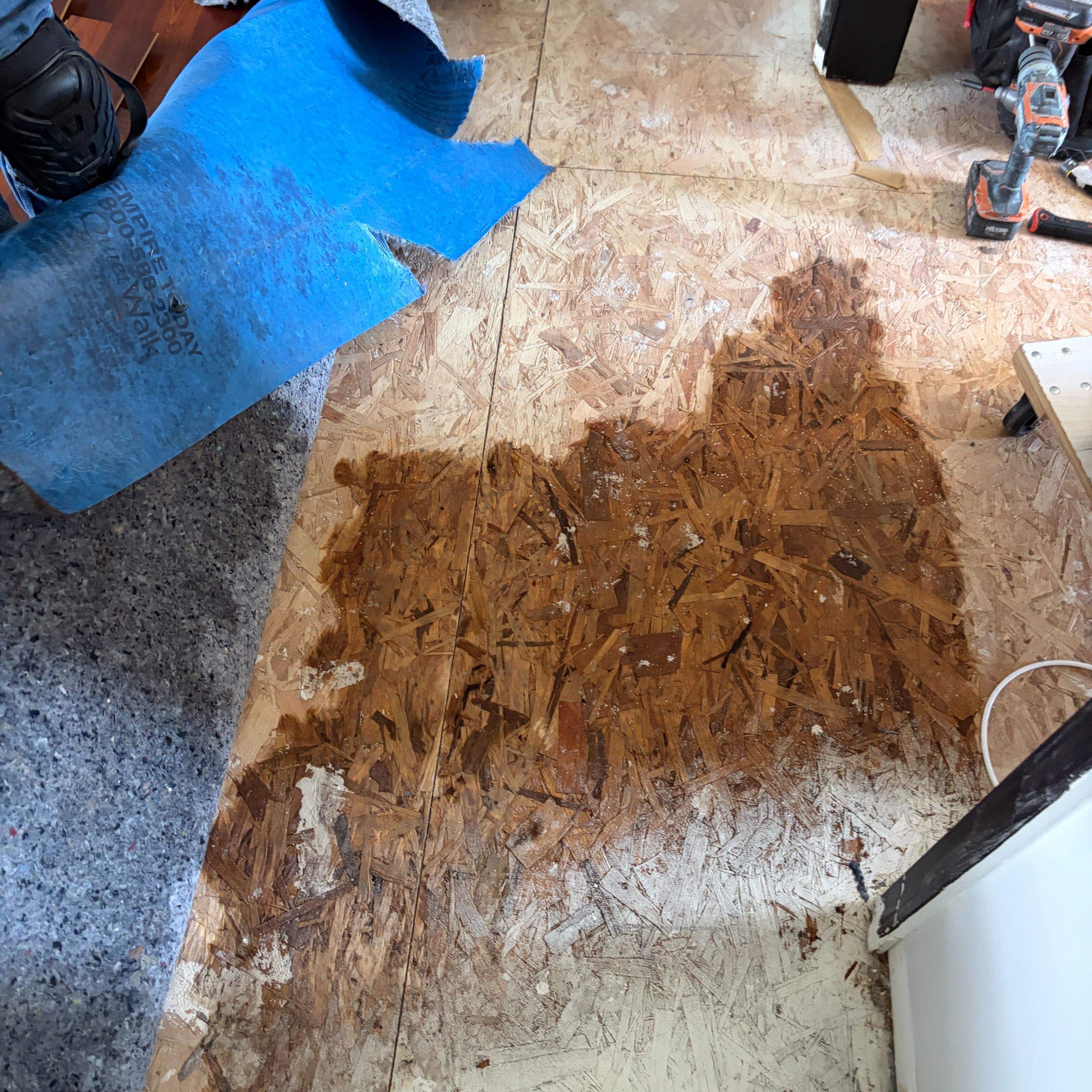
What Counts as a Water Damage Emergency
Not every leak needs a midnight call. These do.
- Active flooding from a burst pipe, supply line, or appliance hose
- Sewage backup through floor drains, toilets, or tubs
- Storm intrusion through roof, windows, or foundation cracks
- Water pooling near electrical outlets, panels, or HVAC equipment
- Ceilings bulging or sagging from water weight above
- Any standing water over 1 inch in a finished space
- Water sitting longer than 24 hours regardless of source
If you checked one of those, stop reading and call. The rest of this page will still be here.
The First 10 Minutes: What To Do Before We Arrive
- Kill the water source. Main shutoff is usually near the water heater, in the basement, or at the curb. Label it now if you ever get a calm moment.
- Cut the power to affected rooms at the breaker if water is anywhere near outlets or fixtures. Do not stand in water to flip a switch.
- Move what you can. Lift furniture legs onto foil or wood blocks. Get electronics, photos, and documents to a dry floor.
- Pull up area rugs. They wick water into hardwood and pad underneath.
- Take photos and video of everything before you touch it. Your insurance adjuster will ask.
- Open windows if the outside air is drier than inside. Skip this in humid summer weather.
- Call Providence Green Water Restoration. We dispatch 24/7 across Providence Green.
Drying Timeline: What To Expect
- Day 1: extraction, demolition, equipment setup, antimicrobial if needed
- Day 2 to 3: daily moisture monitoring, equipment adjustment
- Day 3 to 5: structure reaches dry standard, equipment removed
- Day 5+: reconstruction begins, drywall, flooring, paint, trim
Most residential losses dry in 3 to 5 days. Hardwood, plaster, and dense concrete can push that to 7 or 10. We do not pull equipment until meters confirm dry standard, period.
IICRC Water Categories You Should Know
The category determines the protocol. Anyone who skips this step is guessing.
- Category 1 (Clean): supply line breaks, sink overflows, rainwater. Lowest risk if handled within 24 to 48 hours.
- Category 2 (Gray): dishwasher or washing machine discharge, aquarium leaks, sump pump failures. Contains contaminants.
- Category 3 (Black): sewage, toilet backflow with solids, rising floodwater, any water sitting long enough to grow bacteria. Requires PPE, antimicrobials, and aggressive material removal.
Category can also escalate. A Category 1 supply line break that sits unaddressed for 48 hours often becomes a Category 2 loss because bacteria multiply in the standing water and saturated materials. That is one reason fast response saves both cost and contents.
If you are dealing with a backup, our sewage cleanup team handles Category 3 losses with the right containment and disposal protocols.
Realistic Cost Ranges in Providence Green
Nobody can quote a final number over the phone, but here are honest ranges based on what we see across Central Indiana.
- Small Category 1 loss, one room, fast response: $1,200 to $3,500
- Finished basement, partial flooding, 3 to 5 day dry: $3,500 to $8,500
- Whole basement flood with Category 2 water: $7,500 to $15,000
- Sewage backup with Category 3 protocols: $8,000 to $20,000+
- Multi-floor loss with ceiling and structural drying: $12,000 to $30,000+
For a deeper breakdown by line item, see our complete price breakdown of water damage restoration costs.
What a Providence Green Water Restoration Emergency Response Looks Like
Here is the actual sequence when our crew arrives at your Providence Green property, usually within 60 to 90 minutes of your call.
- Scope and safety check: tech walks the loss, confirms power is safe, identifies the water category
- Source verification: we confirm the leak is stopped or coordinate a plumber if needed
- Moisture mapping: thermal imaging and penetrating meters find water you cannot see behind walls and under floors
- Extraction: truck-mounted units pull standing water at hundreds of gallons per hour
- Content handling: we move, document, and stage salvageable items
- Controlled demolition only where needed: baseboards off, drill holes for wall cavity drying, drywall flood cuts at 2 or 4 feet if saturation requires it
- Drying setup: air movers and dehumidifiers placed per IICRC S500 calculations, not guesswork
- Documentation: moisture readings logged daily, photos, and a scope your insurance can actually use
What Slows Down a Dry-Out
If your drying timeline is creeping past day 5, one of these is usually the reason.
- Equipment turned off overnight by a homeowner trying to save on the electric bill
- Trapped water in wall cavities that was never accessed with drill holes
- Hardwood flooring laid over saturated subfloor without sufficient airflow underneath
- Ambient humidity creeping in from open windows or doors
- Undersized dehumidification for the affected square footage
- Insulation left in place when it should have been removed and replaced
A good restoration crew adjusts daily. If readings stall, equipment moves, holes get drilled, and the plan changes. Set-it-and-forget-it drying is how mold shows up four weeks later.
Why Providence Green Homeowners Call Providence Green Water Restoration
- Local crews based in Central Indiana, not a national call center
- IICRC certified technicians on every job
- BBB A+ rating since founding in 2018
- Direct insurance billing and adjuster coordination
- Honest scoping: if it is a DIY fix, we will tell you
- 24/7 dispatch with real humans answering the phone
Insurance: What To Say and Not Say
- Do file the claim as soon as you have stopped the source and taken photos
- Do get the claim number before mitigation work begins
- Do ask whether your policy covers Cat 3 water or requires a separate sewer backup rider
- Do not sign anything that assigns your benefits to a contractor you do not trust
- Do not admit fault or guess at the cause to the adjuster, just describe what you saw
- Do not throw away damaged items until they are documented
Providence Green Water Restoration works directly with adjusters, writes Xactimate-compatible scopes, and supplies the moisture logs carriers expect. If your loss is on the commercial side, our commercial water restoration team handles business interruption documentation as well.
Red Flags When Hiring Any Restoration Company
- Demands full payment upfront before work starts
- Cannot show IICRC certification on request
- Refuses to provide a written scope
- Pressures you to sign an assignment of benefits at the door
- Quotes a flat price without inspecting moisture levels
- Will not let you see daily moisture logs
- Shows up in an unmarked vehicle with no uniform or ID
- Cannot give you a local address you can drive to
Common Water Damage Sources in Providence Green Homes
After thousands of jobs across Central Indiana, the same culprits show up again and again.
- Frozen and burst pipes in unheated crawl spaces and exterior walls during January cold snaps
- Failed water heaters past the 10 to 12 year mark, often dumping 40 to 80 gallons before anyone notices
- Washing machine supply hoses that crack at the rubber connection, a 5 minute fix that prevents thousands in damage
- Sump pump failures during spring storms when the power goes out at the worst possible time
- Ice dams forcing meltwater under shingles and into upper floor ceilings
- Toilet supply lines with brittle plastic nuts that fail without warning
- Refrigerator ice maker lines slowly weeping behind the unit for weeks
Catching any of these early is the difference between a $300 plumber visit and a five-figure restoration job.